
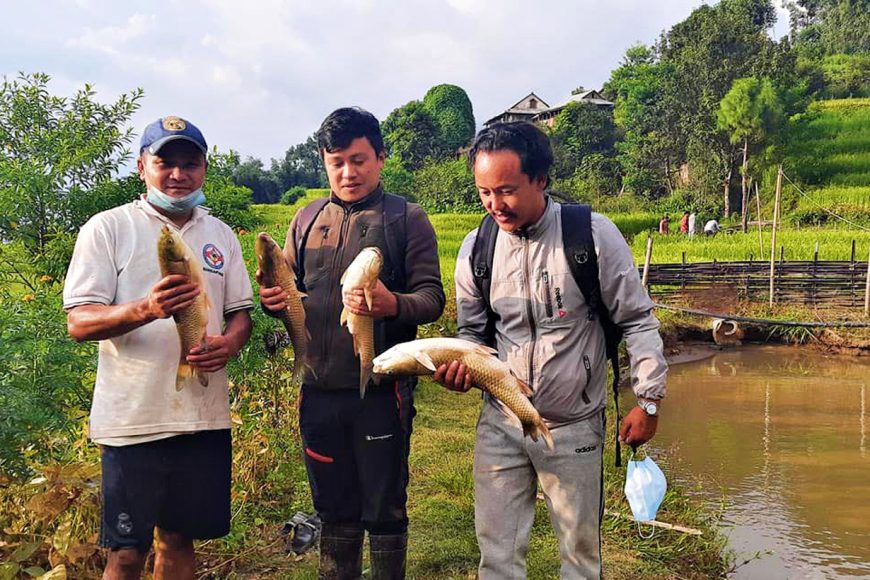
Course Overview
The 7-Week Fish Farming Training Program is a residential skill-development course designed to equip participants with practical and technical knowledge for sustainable aquaculture in Nepal. The training is conducted entirely in the Nepali language and takes place in Godawari, Lalitpur, Nepal.
As a fully residential program, participants are provided with accommodation, meals, and all necessary on-site facilities, creating a focused and immersive learning environment. The course is tailored for youth, returnee migrants, smallholder farmers, and aspiring entrepreneurs interested in fish farming. Participants stay at the institute’s residential accommodation.
Aligned with the curriculum and technical standards of CTEVT Nepal, the training covers essential topics such as species selection, pond construction, breeding, feeding, water management, disease control, harvesting, and marketing. It blends classroom-based instruction with extensive hands-on fieldwork, preparing participants for self-employment or job opportunities in Nepal’s growing aquaculture sector.
Program Schedule
- Duration: 7 Weeks
- Days per Week: Sunday to Friday (6 Days/Week)
- Morning: Theory (2–3 hrs)
- Afternoon: Practical (3–4 hrs)
- Location: Godawari Lalitpur, Neapal
Weekly Breakdown
Week 1: Introduction to Fish Farming & Site Selection
| Day | Morning (Theory) | Afternoon (Practical) |
|---|---|---|
| Sunday | Orientation, scope and potential of fish farming in Nepal | Visit local pond/farm and introduction to fish units |
| Monday | Fish biology and classification | Species ID: Carp, Tilapia, Catfish (demo) |
| Tuesday | Types of aquaculture systems (extensive to intensive) | Sketch different pond systems |
| Wednesday | Site selection, pond layout and design | Marking and layout on sample plot |
| Thursday | Pond construction materials and steps | Excavate model pond or tour constructed pond |
| Friday | Water source, quality and management | Measure pH, turbidity, DO, and temperature |
Week 2: Pond Preparation & Water Quality Management
| Day | Morning (Theory) | Afternoon (Practical) |
|---|---|---|
| Sunday | Liming, fertilization, and pond disinfection | Apply lime and manure to pond |
| Monday | Water cycle and ecosystem in ponds | Install aeration and check for algae |
| Tuesday | Managing aquatic weeds and predators | Weed and predator control demo |
| Wednesday | Water testing (pH, DO, ammonia, etc.) | Use of test kits and field meter |
| Thursday | Pond fencing and protection | Erect a basic bamboo or mesh fence |
| Friday | Mid-week quiz and practical review | Group discussion and error correction |
Week 3: Fish Species, Stocking & Fingerling Management
| Day | Morning (Theory) | Afternoon (Practical) |
|---|---|---|
| Sunday | Major cultivable species: Rohu, Catla, Common Carp, etc. | Visual and weight-based ID |
| Monday | Fish breeding techniques: Natural and induced | Observe hatchery operations or simulation |
| Tuesday | Fingerling selection and transport | Acclimatization practice with fingerlings |
| Wednesday | Stocking density and polyculture systems | Stocking demonstration in demo pond |
| Thursday | Monoculture vs. Polyculture | Design own stocking plan |
| Friday | Health check of fingerlings | Gill and fin examination |
Week 4: Fish Nutrition & Feed Management
| Day | Morning (Theory) | Afternoon (Practical) |
|---|---|---|
| Sunday | Fish feeding habits and dietary requirements | Feed formulation using local materials |
| Monday | Types of feed: Natural, supplementary, compound | Prepare and dry pelleted feed |
| Tuesday | Feed conversion ratio (FCR) and feeding schedules | Practice feeding techniques in the pond |
| Wednesday | Storage and handling of feed | Set up small feed storage bins |
| Thursday | Feeding trial and record keeping | Maintain feed input records |
| Friday | Growth monitoring | Sample catch, weigh, and record fish growth |
Week 5: Fish Health Management
| Day | Morning (Theory) | Afternoon (Practical) |
|---|---|---|
| Sunday | Common fish diseases: Bacterial, fungal, parasites | Observe symptoms from live or video sample |
| Monday | Disease prevention and biosecurity measures | Disinfection of equipment and tools |
| Tuesday | Use of probiotics and herbal remedies | Prepare herbal bath for treatment demo |
| Wednesday | Mortality analysis and response | Collect and log mortality causes |
| Thursday | Vaccination and medication protocols | Administer basic treatments (simulated) |
| Friday | Interactive quiz and diagnosis session | Group diagnosis based on case study |
Week 6: Harvesting, Marketing & Record Keeping
| Day | Morning (Theory) | Afternoon (Practical) |
|---|---|---|
| Sunday | Harvesting techniques and timing | Practice seine net and partial harvest |
| Monday | Post-harvest handling and preservation | Grading, cleaning, and packing fish |
| Tuesday | Market linkage, local trends, and pricing | Visit local fish market or cooperative |
| Wednesday | Costing, budgeting, and profitability analysis | Maintain income-expense sheet |
| Thursday | Record keeping and daily log maintenance | Create logbook templates |
| Friday | Value-added products (dry fish, fillets, etc.) | Practice simple value-added product |
Week 7: Business Planning, Exposure Visit & Certification
| Day | Morning (Theory) | Afternoon (Practical) |
|---|---|---|
| Sunday | Entrepreneurship and business model for fish farming | Prepare individual business plans |
| Monday | Financial literacy: Loans, subsidies, insurance | Prepare budget and proposal |
| Tuesday | Exposure visit to commercial fish farm | Observation and experience sharing |
| Wednesday | Final theory assessment | Review, corrections, and prep |
| Thursday | Final practical assessment | Stocking, sampling, harvesting demo |
| Friday | Certification and graduation ceremony | Presentation, feedback, group photo |
Program Highlights
- Residential training with practical pond exposure
- Fully conducted in the Nepali language
- Developed per CTEVT Nepal’s curriculum structure
- Covers extensive to semi-intensive fish farming
- Includes marketing, business planning, and field visits